
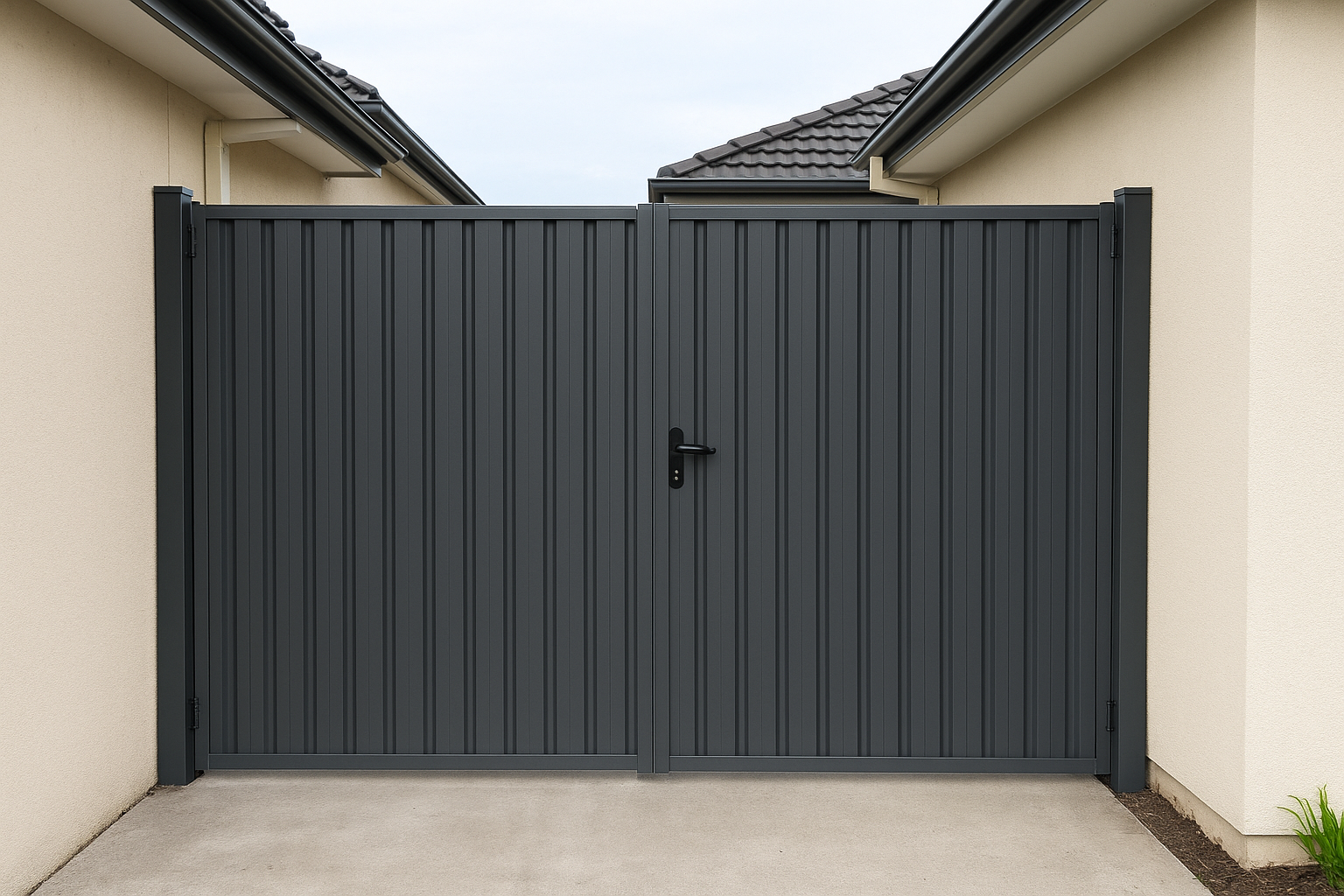
If you’ve been searching for Colorbond fencing in Melbourne and want a straight answer about which fence type suits your property, your budget, and Melbourne’s climate — you’re in the right place. Colorbond steel is Australia’s most widely installed residential and commercial fencing material, and for good reason: it handles UV exposure, coastal salt air, and Melbourne’s notoriously variable weather better than virtually any alternative, with minimal ongoing maintenance required.
But “Colorbond fencing” isn’t a single product. It’s a broad category that includes standard corrugated and flat-panel fences, blade and slat fences, Colorbond fences paired with concrete or timber sleeper bases, woodland and heritage colour ranges, and commercial-grade systems designed for industrial perimeter security. This guide covers every one of them — and helps you understand which solution fits your specific project before you speak to an installer
SF Fencing supplies and installs the full spectrum of Colorbond and steel fencing solutions across Melbourne — including blade fences, slat fences, commercial and industrial perimeter fencing, and security and chainlink systems. Read on for the complete picture.
Why Colorbond Fencing Dominates Melbourne Homes and Businesses
BlueScope Steel developed Colorbond specifically for Australian conditions — and Melbourne’s climate is a genuine test for any fencing material. With UV radiation levels consistently high throughout summer, coastal salt air affecting suburbs from Port Melbourne to Williamstown, and temperature swings that can see a 20°C variation in a single day, the demands on outdoor materials here are significant.
Colorbond’s steel substrate is coated with ZINCALUME® steel technology, then a pre-painted finish using Activate® technology — a zinc, magnesium, and aluminium alloy system engineered to provide self-sacrificial corrosion resistance at cut edges and scratches. According to BlueScope Steel, Colorbond products are tested against Australian Standard AS/NZS 2728 for prepainted metal — the benchmark for performance in our local climate.
Beyond weather performance, Colorbond offers a curated 22-colour palette developed specifically for Australian residential and commercial aesthetics — including the increasingly popular Woodland Grey®, Basalt®, and Monument® — letting Melbourne property owners coordinate fences with rooflines, cladding, and landscaping with precision.
Key reasons Melbourne fencing installers and property owners choose Colorbond
- Engineered for Australian UV radiation, salt air, and thermal cycling — tested to AS/NZS 2728
- Minimal maintenance — no painting, sealing required after installation, needing only a seasonal freshwater hose-down to maintain structural warranty compliance
- Non-combustible steel construction — an advantage in Melbourne’s bushfire interface zones under AS 3959
- 22-colour palette designed for Australian architectural palettes and residential streetscapes
- Available supply-only or complete supply and install through SF Fencing across Melbourne
- Suitable for residential, commercial, and heavy industrial applications
Every Colorbond & Steel Fencing Solution SF Fencing Installs in Melbourne
From a classic residential boundary fence to a full industrial perimeter system — SF Fencing has the product range, materials supply, and Melbourne-based installation teams to deliver every project properly.
Standard Colorbond Fence
The most widely installed residential fence in Melbourne. Corrugated or flat-panel steel, available in all 22 Colorbond colours, in heights from 1.2m to 2.4m.
Woodland Colorbond Fence
Colorbond specified in the iconic Woodland Grey® — Melbourne’s most requested contemporary fencing colour, coordinating with native landscaping and modern architecture.
Colorbond with Timber Sleepers
Steel panels above, treated hardwood sleepers below. Ideal for sloped Melbourne blocks where gaps between ground and panel need a warm, natural solution.
Colorbond with Concrete Sleepers
Precast concrete sleepers slotted between steel H-posts for integrated retaining and privacy — the preferred solution for Melbourne’s steep suburban blocks.
Blade Fence
Custom-fabricated vertical or horizontal steel blade systems — Melbourne’s signature contemporary fencing style for front boundaries, driveways, and pool surrounds.
Slat Fence & Louvres
Horizontal slat fencing and louvre systems in Colorbond, aluminium, or composite — for pool areas, entertainment zones, and commercial facade screening.
Sloped Timber Lap Fence
Traditional lapped board fencing for Melbourne’s established suburbs — including the classic Box Hill style — that follows sloped ground naturally.
Industrial & Security Fencing
Chainlink, welded mesh, and heavy-duty perimeter systems for Melbourne’s commercial and industrial precincts — supply, install, and access gate integration.
Residential Colorbond Fencing Options in Melbourne: What Actually Suits Your Block
Residential fencing projects across Melbourne — from Box Hill townhouses to bayside family homes in Sandringham — typically fall into one of the following categories. Understanding each one helps you shortlist what actually suits your property before you get quotes.
Standard Colorbond Fence: Melbourne’s Most-Installed Residential Solution
The standard Colorbond fence uses corrugated or flat steel panels mounted between galvanised steel posts, with a capping rail along the top. It’s the most widely installed residential fence type across greater Melbourne — straightforward to install, available in all 22 Colorbond colours, and suitable for flat or gently sloped blocks. Heights typically range from 1.2m to 2.4m depending on privacy requirements and local council guidelines.
For Melbourne properties on sloped terrain, the standard fence can be installed in stepped sections — each panel dropped by one increment to follow the ground — or raked, where panels follow the slope continuously. The right approach depends on the steepness of your block and your aesthetic preference. Stepped fencing works well where the slope is moderate and the visual break between panels is acceptable; raked installation creates a cleaner, more contemporary result where the slope is consistent.
Woodland Colorbond Fence: Melbourne’s Contemporary Colour of Choice
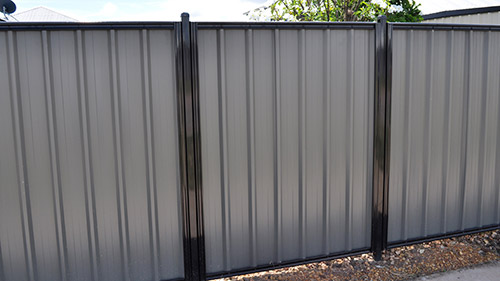
The Woodland Colorbond fence refers to fencing specified in Woodland Grey® — one of the most-requested Colorbond colours in Melbourne’s contemporary residential and commercial market. The warm grey-green tone coordinates with timber, concrete, and dark metal elements that define Melbourne’s modern architectural vernacular. It’s particularly popular in inner-east suburbs like Kew, Hawthorn, and Balwyn, where weatherboard homes and contemporary renovations often share a street.
Woodland Grey also performs well visually as a backdrop to native plantings — lomandra, kangaroo paw, and grevilleas all read beautifully against it. This is another reason it’s become the go-to specification for Melbourne landscape architects and designers working on residential projects where the fence is part of the overall garden design, not just a boundary marker.
Colorbond Fence with Timber Sleepers: Warmth Meets Steel
A Colorbond fence with timber sleepers combines the durability of steel panels with the natural warmth of treated hardwood or recycled timber at the base. This combination is ideal for sloped blocks where the gap between the ground and the bottom of a standard panel would otherwise leave an opening — sleepers fill the gap while providing a visually grounded, finished look.
Treated pine, hardwood species, and recycled railway sleepers are all commonly used across Melbourne. Hardwood species like spotted gum and ironbark are preferred for their resistance to moisture and insect damage. All timber sleepers in ground contact should be treated to at least H4 classification for in-ground use in contact with soil, though H5 treatment is the preferred standard for structural retaining applications to ensure maximum resistance to moisture and decay per Australian Standard AS 1604 — your installer should be able to confirm the treatment class of any sleepers they supply.
Colorbond Fence with Concrete Sleepers: The Retaining Solution
For Melbourne properties where retaining is required alongside the fence — common on steep suburban blocks in areas like Doncaster, Templestowe, and the Dandenong Ranges foothills — a Colorbond fence with concrete sleepers provides both a retaining wall and a privacy fence in a single integrated system. Precast concrete sleepers slot between steel H-posts and can stack to retain significant height differentials, with Colorbond panels continuing above.
Concrete sleepers are available in textures including woodgrain, smooth, and split-face finishes. They do not rot, warp, or require maintenance once installed, and are the preferred choice for boundary fences where soil movement, water drainage, or neighbouring property level differences are factors. For significant retaining heights, always consult your installer about engineering requirements — large retaining structures may require a building permit and structural engineering sign-off under the Victorian Building Authority’s guidelines.
Sloped Timber Lap Fence & Box Hill Timber Lap Fence: Character for Established Suburbs
Timber lap fencing — particularly the classic style seen throughout Box Hill, Balwyn, Hawthorn, and Kew — remains a popular choice in Melbourne’s established suburbs, especially where period architectural character is a consideration. A sloped timber lap fence uses overlapping horizontal or vertical boards that follow sloped ground naturally, making it well-suited to Melbourne’s uneven inner-suburban blocks.
The Box Hill timber lap fence style typically refers to a vertical lapped pale or board configuration — boards fixed with a slight overlap — creating a solid, traditional fence appearance. It suits properties in heritage overlay areas where modern steel fencing may require additional council consideration under the relevant Melbourne metropolitan planning scheme. Timber fencing requires more ongoing maintenance than Colorbond — regular staining or painting every few years extends its life significantly — but offers a warmth and character that many Melbourne homeowners in period streetscapes genuinely prefer.
The Victorian Building Authority (VBA) provides guidance on when fencing work in Victoria requires a building permit — worth checking before any significant fence replacement or new installation project.
Blade Fence & Slat Fence Melbourne: Contemporary Design Meets Function
If there’s a fencing style that defines Melbourne’s contemporary residential design scene right now, it’s the blade fence. Walk through any newly developed street in Fitzroy North, South Yarra, Brunswick East, or the Docklands-adjacent suburbs and you’ll see them: clean vertical or horizontal steel blades creating visual interest while maintaining selective privacy — and looking exceptional doing it.
What Makes a Blade Fence Different?
A blade fence uses individual flat steel blades — typically 65mm to 150mm wide — mounted at set spacings on a welded steel frame. The spacing and blade angle can be adjusted to control privacy levels: closely spaced blades on a straight run create near-total privacy when viewed head-on, while angled blade configurations allow airflow and filtered light while screening direct sightlines from the street or a neighbouring property.
Blade fences are custom-fabricated to suit individual site dimensions and design briefs. They’re available in a wide range of powder coat colours — including the popular matte black, charcoal, and Dulux-matched heritage whites — and can be combined with Colorbond infill panels for sections requiring additional screening without losing the blade fence aesthetic overall. SF Fencing’s fabrication capability means blade fences are designed and built to exact site specifications, not approximated from a catalogue.
Louvres Melbourne: Slat Fencing with Intelligent Ventilation
Louvre and slat fencing in Melbourne is closely related to blade fencing, but with a specific emphasis on airflow management. Louvre blades are angled to redirect prevailing winds while maintaining screening — particularly useful for Melbourne’s bayside and hillside properties where wind management is a genuine design consideration, not just a cosmetic one.
Horizontal slat fences using Colorbond or aluminium extrusions have become the preferred choice for pool fencing surrounds, outdoor entertainment area screening, and commercial facade applications across Melbourne. Their clean horizontal lines complement the low-roofline architecture popular in Melbourne’s contemporary townhouse and unit development market. A slat fence in Melbourne can be fabricated in Colorbond steel, powder-coated aluminium, or composite materials — each offering a different trade-off between weight, cost, and design flexibility.
Commercial Fencing Melbourne & Industrial Fencing Solutions
Commercial and industrial fencing projects in Melbourne operate under fundamentally different requirements to residential jobs. Site security, perimeter management, compliance with workplace safety legislation, and fencing systems that withstand vehicle impact, heavy equipment, and continuous industrial exposure all shape the specification. Getting the specification right from the outset avoids costly remediation later.
Industrial Perimeter Fencing Melbourne
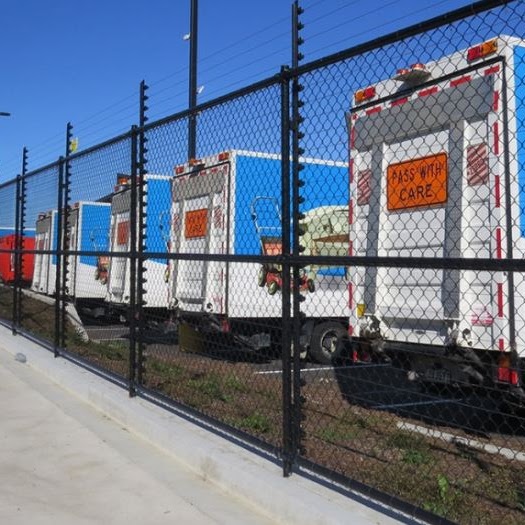
Melbourne’s western and south-eastern industrial corridors — encompassing Laverton North, Altona, Dandenong South, and the Somerton logistics precinct — contain significant industrial land requiring code-compliant perimeter fencing. Industrial perimeter fencing in these contexts must typically satisfy WorkSafe Victoria requirements for secured site perimeters, relevant metropolitan planning scheme provisions, and Australian Standard AS 1725 for chain link fabric fencing where specified.
Common specifications include galvanised chainlink on steel posts for perimeter definition and through-fence visibility, Colorbond steel panels for office-facing facades where aesthetic consistency matters, and welded mesh security panels for areas requiring higher anti-climb performance. Every industrial fencing project has a different risk profile — the right specification starts with understanding the site’s specific security and operational requirements.
Security and Chainlink Fencing Melbourne
Security and chainlink fencing remains the most cost-effective solution for large-perimeter industrial and commercial sites where visibility through the fence is an operational requirement — logistics yards, construction compounds, sports facilities, water treatment infrastructure, and council assets. Galvanised chainlink withstands Melbourne’s coastal and variable climate conditions without rusting and provides a strong, low-maintenance boundary at a lower upfront cost per linear metre than solid panel alternatives.
For applications requiring enhanced security, chainlink can be specified with barbed wire or razor wire topping, anti-dig skirt panels at ground level, and purpose-built security gates with electronic access control integration. SF Fencing designs and installs complete security perimeter systems for Melbourne commercial and industrial clients — from initial site assessment through to gate automation and access hardware commissioning.
Commercial Fencing Melbourne: Beyond the Boundary
Commercial fencing in Melbourne spans a wide project range: childcare centre and school perimeter fencing (subject to specific height and visibility requirements under Victorian education department guidelines), retail and hospitality boundary fencing, strata complex perimeter systems, and mixed-use development facades where fencing forms part of the architectural envelope. Each has distinct regulatory and design requirements.
The Housing Industry Association (HIA) provides guidance for contractors on compliant fencing practices in Victoria, including commercial construction site fencing requirements. For complex commercial projects, SF Fencing works with builders, developers, and project managers from early specification through to handover.
Colorbond Fencing Supply, Wholesale & Finding Installers Near You in Melbourne
Colorbond Fencing Supply and Install Melbourne
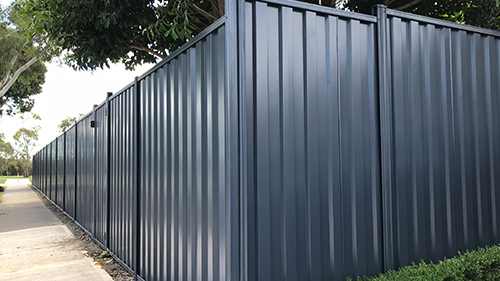
SF Fencing operates as both a Colorbond fencing supply and install specialist and a wholesale materials supplier — making them a single-source solution for Melbourne builders, developers, and property owners who want one contractor managing both materials procurement and on-site installation. This integrated approach eliminates the margin and scheduling complexity of using separate supply and install contractors, and ensures materials quality is controlled throughout.
Colorbond Fencing Wholesale Melbourne
Builders and trade contractors sourcing Colorbond fencing materials at wholesale pricing in Melbourne need a supplier who stocks the full BlueScope range — all panel profiles, post systems, cap rails, and accessories — and can fulfil orders at commercial volumes with reliable lead times. SF Fencing’s wholesale operation is structured for trade accounts, with volume pricing and a team that understands construction project timelines.
Looking for Colorbond Fencing Near Me? Here’s What to Look For
When Melbourne property owners search for Colorbond fencing near me or fencing installers close to their suburb, they’re looking for a contractor who operates locally — one with genuine knowledge of local planning requirements, soil conditions, and council regulations, not a contractor based far away with high travel charges and no awareness of Melbourne’s specific planning overlays.
SF Fencing operates across greater Melbourne, from the inner suburbs to the outer metro growth corridors. Their installation teams are Melbourne-based, and every quote accounts for local site conditions — including Melbourne’s well-documented reactive clay soils, which require specific footing depths and concrete volumes to ensure long-term post stability. For properties in high-bushfire-risk zones on Melbourne’s outer fringe, fencing specifications may also need to align with Country Fire Authority (CFA) guidelines and AS 3959 for construction in bushfire-prone areas — Colorbond’s non-combustible steel construction is directly relevant in these areas.
What to look for when choosing a Melbourne fencing installer
- Demonstrated experience with your specific fence type — residential, commercial, and industrial require different expertise
- Licensed and fully insured — confirm public liability insurance and relevant Victorian building registration
- Itemised written quotes — materials and labour separated, with specific product specifications included
- Knowledge of Melbourne’s local planning requirements — council overlays, permit requirements, Fences Act obligations
- Combined supply and install capability — avoids procurement delays and quality control gaps
- Clear workmanship warranty — separate from the manufacturer’s material warranty
Colorbond Fencing Melbourne: Real Answers to Real Questions
These are the questions Melbourne homeowners, builders, and property managers ask most frequently about fencing. Answered directly, without the fluff.
Q:- How much does Colorbond fencing cost per metre in Australia?
The cost per metre of Colorbond fencing depends on several interconnected factors: fence height, panel profile (corrugated, flat-face, or ribbed), the type and depth of footings required by your soil conditions, site access constraints, and whether you’re comparing supply-only or full supply-and-installation pricing. Ground conditions across Melbourne vary considerably — sandy soils near the bay behave quite differently to the reactive clay common in Melbourne’s middle and outer suburbs, and clay soils often require deeper or larger-diameter footings to ensure long-term post stability.
Always obtain a site-specific quote rather than benchmarking against generic per-metre averages, which rarely reflect actual installed cost once your specific ground conditions, access logistics, and fence height are factored in.
Q:- How much is a 30 metre fence? / How much for a 30m fence?
A 30-metre fence is a medium-sized residential project. Key variables that determine total cost include: fence height, chosen profile (standard Colorbond, blade, slat, or timber lap), ground conditions across the full run, any requirement for concrete or timber sleepers, site access for machinery and post-hole equipment, and whether any demolition and removal of an existing fence is needed. Mobilisation and site setup costs are distributed across the total linear metres — meaning longer runs generally have a more favourable effective cost per metre than very short runs.
For accurate budgeting on a 30-metre project, contact SF Fencing directly on 0451 587 379 for a site visit and itemised quote.
Q:- How much does Colorbond cost per metre?
Colorbond’s per-metre cost varies based on the profile selected (standard corrugated is typically more cost-effective than blade or slat systems), fence height, post spacing, and the complexity of installation — including sloped ground, restricted access, and any requirement for sleeper retaining at the base. Supply-only pricing differs substantially from full supply-and-install, and commercial volume projects attract different pricing structures to residential jobs. SF Fencing offers both wholesale supply and complete installation across Melbourne.
Q:- Are Colorbond fences cheaper than timber fences?
On a pure upfront-cost basis, a basic pine paling fence can appear less expensive to install than a Colorbond fence. However, this comparison misses the full lifecycle picture. Timber fencing requires ongoing maintenance — staining or painting every two to four years, replacement of individual boards that split, rot, or warp, and eventual full replacement much sooner than steel. Colorbond, by contrast, is engineered for a service life of 20 to 30+ years and requires minimal upkeep, needing only a periodic freshwater rinse to maintain its factory finish and warranty compliance.
Over the full lifespan of the fence, Colorbond is almost always the more economical choice — particularly in Melbourne’s climate, where seasonal extremes and variable humidity accelerate timber deterioration.
Q:- What is the most inexpensive fence to put up? What is the cheapest fence to install on a budget?
Chainlink fencing and basic timber paling fences carry the lowest upfront installation cost of any full fence system. For budget-conscious Melbourne property owners who need a functional residential boundary fence with good long-term value, a standard Colorbond fence in a classic profile represents an excellent balance between upfront cost and total cost of ownership — particularly when zero maintenance expenditure over its service life is factored in.
The true cheapest fence to own is rarely the cheapest fence to install. Chainlink is the appropriate choice for large-perimeter security applications; for residential privacy fencing, standard Colorbond offers the best overall value proposition.
Q:-What kind of fence adds the most value to a property?
Fences that consistently enhance kerb appeal and perceived property value in Melbourne combine visual impact, privacy, durability, and contemporary design. Blade fences and slat fences — particularly in powder-coated black, charcoal, or white — are consistently specified by Melbourne architects and developers for properties where first impressions matter. A Colorbond fence with a concrete sleeper base or a rendered brick plinth also elevates the visual quality of a standard boundary fence substantially.
The key principle: fences that look premium, require zero visible maintenance, and complement the architectural style of the home add the most measurable value. A peeling, weathered timber fence actively detracts from property value; a well-specified blade or contemporary Colorbond fence actively enhances it.
Q:- How long does a cheap fence usually last?
A budget pine paling fence — untreated or under-maintained — typically lasts between 8 and 15 years in Melbourne’s variable climate before requiring significant repair or full replacement. Treated hardwood performs better, generally lasting 15 to 25 years with proper maintenance including regular staining and timely replacement of damaged boards. Colorbond steel is engineered for a service life exceeding 20 to 30 years under normal conditions, with no painting or sealing required at any point.
The realistic takeaway: the cheapest fence to install is often the most expensive fence to own over a decade or more when maintenance costs and earlier replacement cycles are accounted for.
Q:- How much does a 10 metre fence cost?
A 10-metre fence is a short run, and mobilisation costs — labour travel, site setup, equipment hire — represent a larger proportion of the total bill than on longer projects. This means the effective cost per metre for short runs tends to be proportionally higher than for 30-metre or longer projects. Whether you’re fencing a gate return, a side access, or a small section of boundary, the best way to understand your total cost is to have the site assessed directly by SF Fencing.
Q:- How much should I budget for a new fence?
Budgeting for a new fence in Melbourne requires understanding the key cost drivers: total linear metres required, fence height and style, soil and ground conditions (which directly affect footing size and depth), site access for machinery, any sloping that requires stepped panels or sleepers, demolition and removal of an existing fence, and whether a council planning or building permit is needed.
In Victoria, the Fences Act 1968 governs cost-sharing obligations between neighbours for dividing fences — understanding your rights and obligations here before you start the project avoids disputes later. Always obtain at least two itemised quotes that separate materials from labour.
Q:- How to make a fence look nice on a budget?
Several approaches can dramatically lift the appearance of a fence without a major cost increase. Choose a contemporary Colorbond colour like Woodland Grey® or Basalt® rather than the standard Surfmist or Paperbark — the colour selection alone changes the visual impact substantially. Add a concrete sleeper base to elevate the fence off ground level and create a layered, designer look. Select a flat-panel Colorbond profile rather than corrugated for a more modern aesthetic. Train climbing plants — star jasmine, hardenbergia, or native pigface — along the fence line to soften and naturalise the structure. Maximise fence height within council guidelines to deliver the best possible privacy impact.
These specification and design decisions have an outsized visual effect at minimal additional cost — they’re the choices experienced Melbourne installers make when a client wants premium results on a practical budget.
Q:- Do I need a permit for a Colorbond fence in Melbourne?
In most Melbourne residential situations, a standard Colorbond dividing fence up to 2 metres high does not require a planning or building permit — but this depends on your local council’s planning scheme, whether your property is in a heritage overlay, flood zone, or bushfire management overlay, and whether the fence is on a front or side boundary. Front fences in many Melbourne council areas have height restrictions and may require council approval before installation.
Check with your local council and the Victorian Building Authority before starting any fencing project to confirm requirements specific to your property and street. SF Fencing’s team is familiar with permit requirements across Melbourne’s metropolitan councils and can advise during the quoting process.
Q:- What Colorbond colours are available for fencing in Melbourne?
BlueScope’s current Colorbond palette includes 22 colours across earthy, neutral, and heritage ranges. The most requested colours in Melbourne for residential fencing are currently Woodland Grey®, Basalt®, Monument®, Ironstone®, and Surfmist®. Shale Grey® and Evening Haze® are popular for properties seeking a lighter, more coastal aesthetic. For commercial and industrial applications, Colorbond Gravel® and Windspray® are frequently specified for their neutral, low-visibility character. The full current palette is available on the BlueScope Steel website.
How to Choose the Right Fencing Installer in Melbourne
Fencing is a long-term structural investment for any Melbourne property. Poorly set posts in reactive clay soil, undersized footings, incorrect panel installation, or substandard materials can mean a fence that looks poor and fails early — regardless of how good the Colorbond panels themselves are. Who installs your fence matters as much as what they install.
- Demonstrated experience with your specific fence type
- Licensed and fully insured operator
- Itemised, written quotes — materials and labour separated
- Knowledge of Melbourne planning and council requirements
- Combined supply and install capability for scheduling control
- Clear workmanship warranty distinct from material warranty
- Local Melbourne-based installation teams — no interstate crews
- Familiar with Melbourne’s reactive clay soil footing requirements
SF Fencing’s teams are Melbourne-based, experienced across the full residential and commercial fencing range, and operate as a combined supply-and-install business — meaning materials quality and installation execution are both managed under one roof. For large commercial and industrial fencing projects, SF Fencing works directly with builders, developers, and project managers from initial specification through to final handover and compliance documentation.