
Thinking about upgrading your fence but not sure whether louvre panels are the right choice? In this guide, we walk you through every application — from street-facing front yards to balcony privacy screens and compliant pool barriers — so you can make the smartest decision for your Melbourne property.
Have you ever driven past a Melbourne home with a sleek, slatted fence and wondered why it looked so much more considered than every other boundary on the street? Chances are you were looking at louvre fencing — and there’s a very good reason it’s become the go-to choice for architects, renovators, and homeowners right across Greater Melbourne.
Louvre fencing uses angled or horizontal aluminium blades to give you privacy, airflow, and a modern aesthetic all at once. Unlike solid panel fencing that simply blocks everything, louvres give you control — over how much you’re seen, how much breeze moves through your space, and how much sunlight reaches your garden or outdoor entertaining area.
In this guide, we cover the three most popular applications: front yard louvre fencing for street appeal and security, balcony louvre screens for apartment and townhouse privacy, and pool area louvre fencing that meets Victoria’s compliance requirements without looking like a legal obligation.
If you’re already confident louvre fencing is what you need, you can explore SF Fencing’s louvers and cantilevered sun shade louvre service or request a free measure and quote. Otherwise, read on — this guide will give you everything you need to make the right call.
Table of Contents
ToggleWhat is louvre fencing?
Louvre fencing consists of a series of flat or aerofoil-shaped blades mounted between vertical posts at a fixed angle — typically between 30° and 45°. The angle is the key: it blocks direct sight lines from the street or neighbours while allowing air and diffused light to pass through freely.
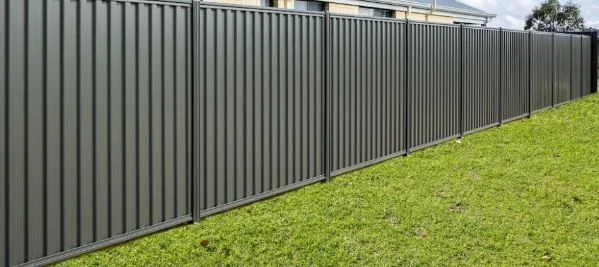
In the Melbourne context, aluminium is the dominant material for louvre fencing and privacy screens. It’s lightweight, doesn’t rust or rot, handles our unpredictable four-seasons-in-a-day weather without warping, and accepts powder-coat finishes in a virtually unlimited colour range. You can match Colorbond fencing, match your home’s render or cladding, or go with a timber-look finish for warmth without the maintenance headache of real wood.
Privacy without isolation
Blocks sight lines from ground level while allowing light and breeze to flow freely through the blades.
Durable aluminium construction
Won’t rust, rot, crack, or require repainting. Powder-coat finishes carry long-term colour warranties.
Design flexibility
Horizontal or vertical orientation, custom blade size and spacing, any powder-coat colour you like.
Airflow and ventilation
Unlike solid panel fencing, louvres allow natural ventilation — especially valuable for pool plant rooms and tight side passages.
Adds property value
Modern louvre fencing is consistently cited by real estate agents as a kerb appeal upgrade that supports higher asking prices.
Custom fabrication
Every panel is made to measure for your exact site — angles, posts, heights, and gate integration are all tailored to your property.
Application 1: Louvre fencing for Melbourne front yards
Your front fence is the first impression your home makes — and in Melbourne, that matters. Whether you’re in a period terrace in Fitzroy, a new build in Tarneit, or a double-storey in Glen Waverley, the front fence frames your property and signals to anyone walking or driving past what kind of home it is.
Why louvres work so well at the front of a property
Front yard louvre fencing sits in a sweet spot that other fencing materials struggle to occupy. Solid rendered walls or timber paling can feel oppressive at the street edge. Tubular steel or picket fencing is open but offers no privacy at all. Louvres give you the visual weight and presence of a solid fence without the “fortress” feeling — the light-and-shadow play across the blades adds architectural texture that looks genuinely designed.
They’re also highly practical. A horizontal louvre fence angled away from street level prevents anyone walking past from looking directly into your front yard or veranda, while still allowing you to see out (and light in) from inside the property. That asymmetric privacy is something almost no other fence type delivers.
Melbourne council regulations for front fencing
This is where a lot of Melbourne homeowners come unstuck, so it’s worth covering clearly. Victoria’s fence height rules draw from the Building Regulations 2018, the Fences Act 1968, individual council planning schemes, and ResCode standards A20 and B32. The short version:
- Front boundary fences are generally limited to 1.2 metres in height along the front boundary without a planning permit in most residential zones
- Within 9 metres of an intersection, height is limited to 1 metre to preserve traffic sight lines
- Side boundary fences behind the front setback can typically reach 1.8–2.0 metres
- Some heritage overlay areas have additional design controls that may affect louvre style or colour
The good news: because louvre fencing allows partial visual permeability, many councils view it more favourably than solid panel fencing when assessing streetscape impact. Always check with your local council before building — SF Fencing can assist with this as part of our design and quoting process.
Application 2: Louvre screens for Melbourne balconies
With Melbourne’s medium- and high-density housing boom continuing through 2025 and 2026, balcony privacy has become one of the most common reasons homeowners and body corporate managers contact SF Fencing. Apartments, townhouses, and dual-occupancy homes are being built closer together than ever — and enjoying your balcony without feeling like you’re on display is no longer a given.
Fixed vs adjustable balcony louvre screens
Fixed louvre panels are the most common solution. The blades are set at a permanent angle — typically angled down and away from neighbours’ sight lines — giving you consistent privacy without any mechanical components to maintain. They’re ideal for balconies that face another building, a busy street, or a neighbour’s upper-storey windows.
Adjustable louvre systems include motorised versions where all blades rotate together via a single control. These are particularly popular for larger balconies that function as outdoor rooms — you can open the louvres fully on a cool morning and close them when the afternoon sun or neighbouring noise becomes an issue.
Overlooking regulations in Victoria
Victoria’s ResCode includes specific overlooking provisions (Standards B22 and A14) that govern habitable room windows and private open space. In practical terms, this means new windows or balconies that overlook a neighbour’s private open space or habitable rooms within 9 metres must include screening to a height of 1.7 metres above finished floor level.
For existing properties that have become privacy issues due to new construction nearby, cantilevered sun shade louvre systems installed over windows or balcony edges are one of the most effective compliance and privacy solutions available — and they’re a core part of SF Fencing’s offering.
Application 3: Louvre fencing around Melbourne pool areas
Pool fencing in Victoria isn’t optional — it’s a legal requirement governed by the Building Regulations 2018 (Part 9A) and Australian Standard AS1926.1. Getting it wrong carries real consequences: fines, forced removal, and the genuine safety risk of an unbarriered pool around young children.
The challenge is that compliance requirements can make pool fencing feel clinical and institutional. Louvre fencing solves this beautifully — it lets you meet every technical requirement while creating a pool surround that looks like a design decision rather than an obligation.
Victoria’s pool fence compliance requirements
- Minimum barrier height of 1.2 metres above natural ground level
- Maximum gap of 100mm between vertical elements and under the bottom rail
- A 900mm non-climbable zone (NCZ) on the outside of the barrier — no furniture, plants, or structures that could assist climbing
- Where a boundary fence forms part of the pool barrier, it must be at least 1.8 metres high
- Gates must be self-closing and self-latching, with the latch at least 1.5 metres from the ground
- All pools holding more than 30cm of water must be registered with your local council
- Mandatory inspections every four years from 2025
Aluminium louvre fencing can be configured to meet all of these requirements while still maintaining the clean, modern aesthetic that makes your pool area a feature of your garden rather than a liability zone.
Louvre fencing vs other options: how they compare
Before committing, it helps to understand where louvre fencing sits relative to alternatives. Here’s a plain-language comparison across the factors Melbourne property owners care about most.
| Feature | Aluminium louvres | Solid panel / Colorbond | Timber slat fencing | Glass balustrade |
|---|---|---|---|---|
| Privacy | ✓ High (angled blades) | ✓ Complete | ✓ High (dense spacing) | ✗ None |
| Airflow | ✓ Excellent | ✗ None | Moderate | ✓ Excellent |
| Maintenance | ✓ Very low | ✓ Very low | ✗ High (painting, sealing) | Moderate (cleaning) |
| Rust / rot risk | ✓ None | ✓ None (steel) | ✗ Yes (rot, termites) | ✓ None |
| Architectural appeal | ✓ Very high | Moderate | Moderate–high | ✓ Very high |
| Lifespan | 25–40+ years | 20–30 years | 10–20 years | 20–30 years |
| Custom colours | ✓ Unlimited (powder coat) | Limited (Colorbond range) | Paintable (needs maintenance) | Tinted glass options |
| Council compliance (front yard) | ✓ Generally well-received | Often restricted by streetscape controls | Variable by council | Height restrictions apply |
| Pool compliant (with design) | ✓ Yes | ✓ Yes | Yes (with conditions) | ✓ Yes |
Louvre fencing design ideas for Melbourne homes
One of the most common questions we get at SF Fencing is: “What colours and configurations actually work?” Melbourne’s architecture is extraordinarily diverse — Victorian terraces, 1970s brick veneers, Hamptons-style new builds, contemporary concrete-and-glass projects — and louvre fencing adapts to all of them.
Colour and finish choices
Powder-coat finishes are the industry standard for aluminium louvre fencing. The coating is baked on at high temperature, creating a surface that resists chipping, fading, and UV degradation far better than liquid paint. You can specify any custom colour from a powder coat range — common Melbourne choices include:
- Monument or Charcoal: the most popular choice for contemporary builds, pairs well with render, cladding, and concrete
- Woodland Grey or Surfmist: softer neutrals that suit heritage areas and Hamptons-style homes
- Satin Black: a bold choice for architecturally designed homes, typically reserved for accent panels rather than full boundary fencing
- Timber-look finishes: a powder-coat process that replicates the visual warmth of timber grain — popular in Bayside and inner east suburbs where character matters as much as durability
Blade orientation: horizontal vs vertical
Horizontal louvres are the most common orientation in residential applications. They have a low, contemporary profile that suits single-storey homes and long boundary runs. They’re also more effective at blocking sight lines from street level.
Vertical louvres (also known as blade fins) add height emphasis and are particularly effective for balcony screens and facade applications on double-storey homes. They also allow you to orient the fins to block afternoon western sun while maintaining east–west airflow — a practical consideration in western Melbourne suburbs like Tarneit, Point Cook, and Werribee where summer afternoons can be brutal.
Integrating louvre fencing with gates
A common design pitfall is installing beautiful louvre fencing and then fitting a mismatched pedestrian or driveway gate. SF Fencing fabricates matching aluminium gates with louvre blade infills, ensuring the entire front boundary — fence, pedestrian gate, and driveway gate — reads as a single cohesive design. Automated gate options are available for driveways, integrating seamlessly with the louvre fence panels for both aesthetics and convenience. You can explore our residential automatic gate installations for more on this.
What to expect during installation
One of SF Fencing’s most-asked questions is: “How long does it actually take?” Here’s an honest breakdown of what the process looks like from your first call to the final panel going in.
Site measure and consultation
We visit your property, measure the run, discuss design options, blade orientation, colour, height, and gate integration. We also do a preliminary check on council height limits and any heritage overlay implications.
Quote and design sign-off
You receive a detailed quote with panel layout drawings. Once you approve, we go into the fabrication queue.
Custom fabrication
Each panel is fabricated to your exact measurements at our workshop. Typical lead time is 4 weeks from design sign-off for most louvre installations.
Installation
Posts are set in concrete footings, panels are attached, gates are hung and adjusted, and everything is checked for plumb and level. Most residential installations are completed in 1–2 days.
Inspection and handover
We walk through the installation with you, confirm everything meets your expectations, and provide care instructions for the powder-coat finish.
Louvre fencing across Greater Melbourne — suburb considerations
Greater Melbourne spans more than 9,500 square kilometres and dozens of distinct council areas, each with its own character, planning rules, and aesthetic traditions. Here are a few considerations worth knowing if you’re in a specific part of the city.
Inner suburbs (Fitzroy, Collingwood, Richmond, Northcote)
Heritage overlays are common in Melbourne’s inner north and inner east. If your property sits within a Heritage Overlay (HO) under your council’s planning scheme, the design of front fencing may require planning permit approval. Louvre fencing in these areas typically works best when the blade profile is relatively fine and the colour choice is heritage-sympathetic — deep charcoals, warm greys, or black rather than bold contemporary tones.
Western growth corridor (Tarneit, Point Cook, Werribee, Hoppers Crossing)
Melbourne’s western suburbs are where louvre fencing is seeing some of its fastest uptake. New estates are full of contemporary homes where the street presence of a premium front fence makes a real visual difference against the backdrop of similar builds. Western-facing aspects also make the airflow properties of louvre fencing practically valuable — vertical blade orientation to manage afternoon sun is a popular choice here.
Bayside and inner south-east (Brighton, Sandringham, Mentone, Cheltenham)
Coastal proximity in Melbourne’s Bayside corridor means salt air and corrosion are genuine concerns. Aluminium powder-coat is ideal here — it won’t corrode in the way steel or iron fencing eventually does. The architectural character of Bayside tends toward the premium end, and high-quality louvre fencing with fine blade profiles and quality powder-coat finishes fits naturally with the neighbourhood aesthetic.
Northern and north-eastern suburbs (Doncaster, Templestowe, Eltham)
SF Fencing has completed projects in Doncaster and Templestowe (including the louvre shade projects documented on our website). These areas tend toward larger residential blocks with multi-storey homes, where balcony and upper-level privacy screening is a common requirement alongside traditional boundary fencing.
Frequently asked questions about louvre fencing in Melbourne
How much does louvre fencing cost in Melbourne?
Cost varies considerably depending on the linear metres of fencing, blade size, panel height, gate integration, and post type. As a general guide, aluminium louvre fencing in Melbourne typically runs between $350 and $650 per linear metre supply-and-install, depending on specification. Cantilevered sun shade louvre systems for windows are priced per unit based on dimensions. The best way to get an accurate figure is a site measure — contact SF Fencing for a free quote.
Do I need a permit for louvre fencing in Melbourne?
It depends on the location and height. Side and rear boundary fences under 2 metres generally don’t require a permit in most residential zones. Front boundary fences are typically limited to 1.2 metres without a permit. Heritage overlays may require planning permit approval regardless of height. Pool fence installations require inspection and certification. SF Fencing can advise on permit requirements for your specific site as part of the quote process.
Can louvre fencing be used as a compliant pool barrier in Victoria?
Yes — aluminium louvre fencing can be designed to meet Victoria’s pool barrier requirements under the Building Regulations 2018 and AS1926.1. The key requirements are minimum 1.2m height, maximum 100mm gaps, a 900mm non-climbable zone on the outside, and self-closing, self-latching gates with latches at least 1.5m above ground. Blade spacing and size are specified to ensure no footholds that could aid climbing. SF Fencing designs pool barrier louvre fencing to meet all these standards — we recommend engaging a registered building surveyor to issue a compliance certificate after installation.
How long do aluminium louvre fences last in Melbourne’s climate?
A quality aluminium louvre fence with premium powder-coat finish should last 25–40 years or more in Melbourne’s climate. Aluminium doesn’t rust or rot, and modern powder-coat finishes are extremely resistant to UV fading and surface degradation. In coastal areas like Bayside, aluminium is particularly well suited compared to steel or iron alternatives that can corrode under salt air exposure.
What’s the difference between fixed and adjustable louvre fencing?
Fixed louvre fencing has blades set permanently at a specified angle — typically 30–45 degrees. There are no moving parts, which means lower cost, lower maintenance, and a cleaner visual profile. Adjustable (also called operable or motorised) louvre systems allow the blade angle to be changed via a mechanical or motor-driven mechanism. These are more expensive and are generally used for outdoor living structures, balcony enclosures, and architectural screens rather than boundary fencing.
Can louvre fencing be installed on a sloped block?
Yes. Louvre fencing panels can be raked (angled to follow the slope) or stepped (installed in a series of level panels that step up the grade). The right approach depends on the degree of slope and the desired aesthetic. Raked panels give a continuous flowing line that follows the land; stepped panels create a more formal, architectural look. SF Fencing assesses slope during the site measure and recommends the approach that best suits your property.
How do I maintain aluminium louvre fencing?
Maintenance is minimal. Washing the panels down with clean water two to four times a year is generally sufficient to keep the powder-coat in good condition and remove dust, pollen, and bird marks. In coastal areas, a more frequent rinse with fresh water helps remove salt deposits. Avoid abrasive cleaning products or steel wool, which can scratch the powder-coat surface. If a panel is damaged, individual blades can typically be replaced without dismantling the entire fence.
Does louvre fencing provide enough privacy for a front yard?
Yes — the privacy performance of louvre fencing is genuinely high at ground level when blades are angled correctly. A standard 30–45° blade angle effectively blocks the sight line of anyone at street level looking into your front yard or veranda. Louvre panels do not provide total opaque coverage like a solid wall, but for the vast majority of front yard applications the privacy achieved is excellent while still allowing light and airflow. For total visual opacity, a closer blade spacing or a steeper angle can be specified.