
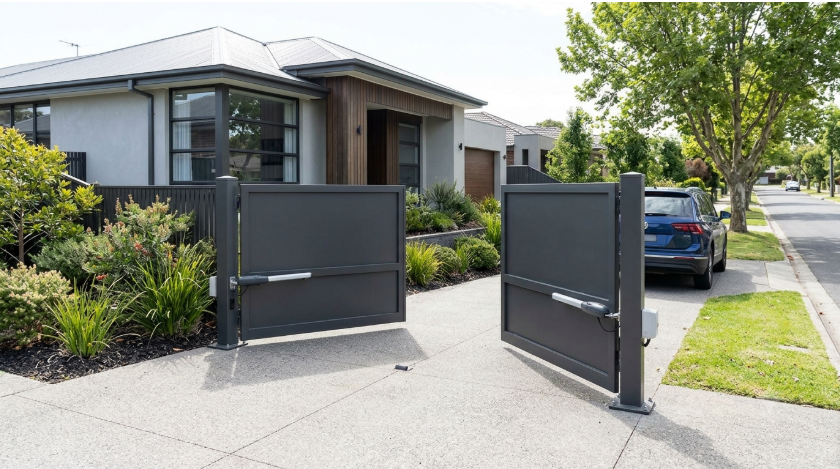
Yes, automatic swing gates may suit many Melbourne driveways if there is enough room for each gate leaf to open, the ground and supporting posts are suitable, and the automation system is correctly specified. However, slopes, parked vehicles, nearby walls and limited space can make a different design more practical.
A gate can look perfect on paper and still scrape a sloping driveway, hit a parked car or open into a space you need every day. That’s why automatic swing gates need more than a quick width measurement.
However, before settling on a design, it’s worth checking how your driveway slopes, where the panels will travel and what the motor needs to operate safely. This guide takes you through seven practical checks, common Melbourne site conditions and what to do when a swing gate isn’t the right fit.
How Do Automatic Swing Gates Work?
Automatic swing gates open by rotating on hinges, much like a regular door. However, instead of being opened manually, each gate leaf is moved by a powered operator connected to a control system.
Depending on the installation, the system may include:
- One gate leaf or a pair of leaves
- Hinges, posts and a supporting frame
- Electric actuators and a control unit
- Remote controls, keypads or an intercom
- Safety devices and an emergency release
- Mains power or a suitably designed solar system
Unlike sliding gates, which travel sideways along an entrance, swing gates require space for the panels to rotate. Consequently, the available driveway depth and the path of each moving leaf matter just as much as the entrance width.
You may explore different designs when planning swing gates in Melbourne, but the final configuration should follow the measurements and conditions of the property.
Check 1 — Measure Your Driveway Gates and Available Swing Clearance
The first check is whether each gate leaf can travel through its full opening arc without striking a vehicle, wall, garden, building or other obstruction. Measure the entrance width, the intended hinge position and the unobstructed depth inside the driveway.
A common mistake is measuring only the distance between the existing fence posts. However, the most important question is what occupies the space where the gate will move after it is installed.
Before proceeding, check:
- The clear width required for vehicles to enter and exit
- The available distance between the entrance and any parked cars
- Nearby walls, steps, garden beds and other obstacles
- The desired opening direction and angle
- Whether a motor or mounting bracket needs additional space
Single vs Double Automatic Driveway Gates
A single swing gate uses one large moving panel. In contrast, double automatic driveway gates divide the opening into two shorter leaves, which can reduce the depth each leaf requires to swing inward.
Nevertheless, a double gate still needs suitable supporting posts, correctly positioned hinges and a clear operating path.
If this check fails: Ask whether a double-leaf design, revised hinge position or sliding gate could provide safer access. Avoid ordering a standard gate based only on the entrance width.
When comparing residential automatic gates, choose the configuration that suits everyday vehicle movements rather than appearance alone.
Check 2 — Assess Driveway Slope and Ground Clearance
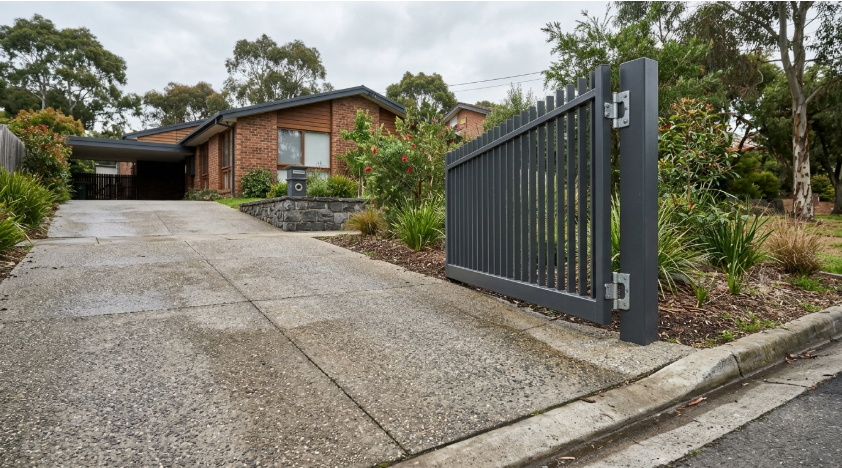 Automatic swing gates may work on sloping driveways, but the gate must clear the ground throughout its entire opening movement. The direction of the slope, its steepness and changes in the paving level determine whether a standard hinged arrangement is suitable.
Melbourne driveways can have uphill gradients, downhill approaches, crossfalls and uneven transitions near the street. Therefore, measuring the ground height only where the gate closes will not reveal every potential obstruction.
Why Rising Driveways Can Cause Gate Clearance Problems
When the ground rises in the direction a gate opens, the bottom of the moving leaf may come into contact with the driveway. Hence, uneven paving, drainage channels and changes in surface level may create similar problems.
Check:
- Whether the driveway rises or falls behind the entrance
- Changes in ground height along the complete gate-opening arc
- Drainage channels, raised paving and uneven surfaces
- Whether the gate needs a different hinge or opening arrangement
If this check fails: Have an installer assess modified gate geometry, suitable specialist hardware or a different gate configuration because raising the gate or changing the motor may not solve every slope-related problem.
Check 3 — Inspect Steel Gates, Hinges and Supporting Posts
A swing gate needs stable posts, correctly aligned hinges and foundations capable of supporting the gate’s weight and operating forces. A motor cannot compensate for a sagging gate or a support that moves under load.
This matters particularly when automating existing steel gates or installing large, solid-panel designs. Heavy leaves, wind exposure and repeated movement all place demands on the supporting structure.
How Gate Weight, Soil and Wind Affect Installation
The condition of the ground around the posts also matters. Depending on the site, fill, moisture changes, drainage or reactive soils may affect the footing design, although these conditions should never be assumed without assessment.
Inspect or ask the installer to check:
- Loose, leaning or visibly damaged gate posts
- Cracked masonry or movement near existing footings
- Worn hinges, rust and misaligned gate leaves
- The weight, width and solid-panel area of the proposed gate
- Wind exposure and the need for durable protective finishes
Melbourne’s exposed properties and bayside environments can present additional wind and corrosion considerations. As a result, material selection and motor sizing should account for local exposure rather than appearance alone.
If this check fails: Arrange a structural assessment before selecting automation equipment. Reinforced supports, replacement hinges, new footings or a lighter gate design may be necessary.
Check 4 — Choose Suitable Gate Automation and Power
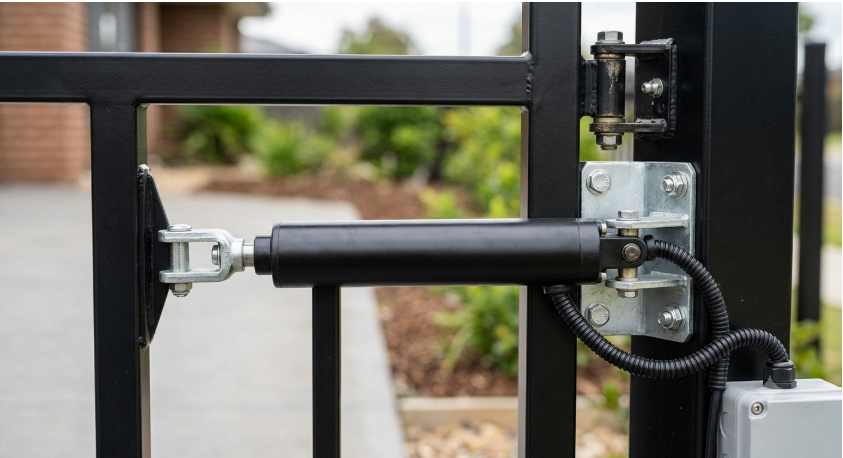
The correct gate automation system must suit the gate’s dimensions, weight, opening geometry and expected daily use. The available power source and control features also influence the equipment required.
A gate that opens only a few times each day may have different motor requirements from an entrance shared by several households. Furthermore, a large solid gate exposed to wind can place different demands on an operator from a lighter open-style design.
Solar vs Mains Power for Gate Automation
Mains power can be a practical choice where a suitable electrical supply is available. Solar can also work, particularly when running a new cable would be difficult, but its reliability depends on winter sunlight, shading, battery capacity and the gate’s power requirements.
Ask about:
- Suitable motor capacity and operating frequency
- Single or double-motor configurations
- Available mains supply and possible electrical work
- Solar panel placement, battery sizing and winter performance
- Remotes, intercoms, keypads and smartphone access
- Emergency manual release and backup arrangements
If this check fails: Obtain a system-specific recommendation before purchasing the motor. However, if electrical supply or solar capacity is inadequate, the installer should explain the alternatives and any additional work required.
A complete gate automation assessment should consider the physical gate, operating equipment and safety features together. You may also check out this guide to electric gates in Melbourne for a broader explanation of available systems.
Check 5 — Assess Security Gates, Safety and Vehicle Access
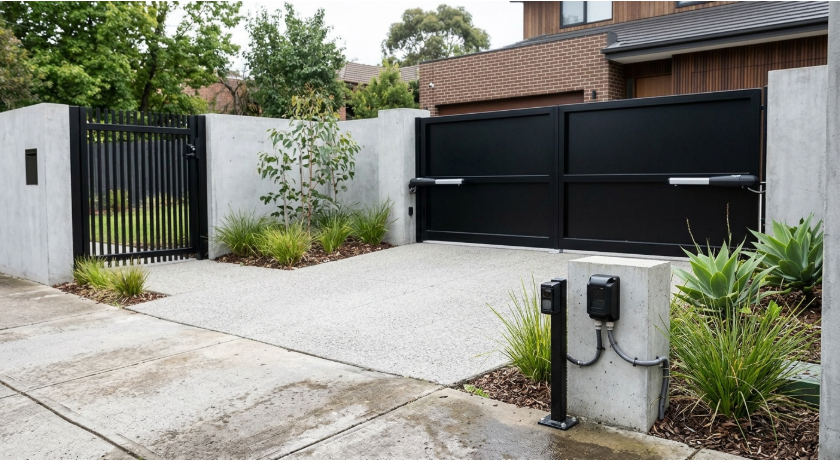
Automatic swing gates must be designed so their movement does not create unacceptable risks for people, animals or vehicles. The assessment should consider the opening arc, hinge areas, closing edges, nearby structures and normal pedestrian routes.
A gate may be physically capable of opening while still being poorly positioned for everyday use. For example, a driveway shared by pedestrians and vehicles needs careful consideration of access arrangements and potential trapping areas.
Check:
- Where children, visitors and pets may enter the gate area
- Potential crushing, shearing and trapping points
- The required safety sensors and control features
- Vehicle turning and waiting positions
- Visibility when entering or leaving the property
- Emergency access and manual release arrangements
Pedestrian Access and Side Gates
A separate pedestrian entrance can make everyday access more convenient. Where practical, side gates may also reduce the need for people to use the main vehicle entrance.
Security gates should combine controlled entry with safe operation; security alone is not a reason to overlook the movement of the gate.
If this check fails: Reconsider the gate location, pedestrian route or access-control design, and arrange a professional safety assessment. Safety devices must be selected and tested for the actual installation.
Shared-access buildings and higher-use sites may need additional consideration of commercial automatic gates, motor duty cycles and vehicle management.
Check 6 — Confirm Melbourne Council, Boundary and Strata Requirements
Before installing automatic swing gates, confirm that the proposed gate and associated fencing work meet the requirements applying to your property. Fence height, title boundaries, planning controls and the proposed opening direction can all affect the design.
Not every Melbourne property has the same planning or building requirements. In addition, a property within an owners corporation may be subject to approval conditions beyond ordinary council requirements.
Before purchasing, check:
- The property’s title boundaries and restrictions
- Front fence height and relevant planning controls
- Whether building or planning approval is needed
- Whether the gate could open into public space
- Requirements affecting a shared driveway
- Owners corporation approval, where applicable
For properties in Wyndham, Wyndham City’s building permit guidance explains front-fence conditions and states that gates must not swing beyond the title boundary into the footpath or road reserve.
If this check fails: Change the proposed layout or seek the required advice and approvals before fabrication. A different opening direction or gate type may be needed.
Check 7 — Compare Installation Costs and Alternative Gate Designs
The total cost of automatic swing gates depends on the complete installation, not simply the price of the motor or gate panels. Site preparation, posts, footings, electrical work, safety equipment and access controls can change the final quotation significantly.
An existing gate may be suitable for motorisation, but only after its frame, hinges and supporting structure have been checked. Likewise, a new installation may require additional work that is not visible in an initial online estimate.
Request an itemised quotation covering:
- Gate fabrication, dimensions and finishes
- Existing gate modifications or replacement
- Posts, hinges and foundations
- Motors, controllers and power requirements
- Safety devices and access controls
- Installation, testing and commissioning
- Optional extras and ongoing maintenance
When Sliding Gates Are More Practical
Sliding gates may be preferable where the driveway has insufficient depth for swing leaves to open but has adequate unobstructed space along the fence line.
They require their own ground, support and travel-space assessment, however. For further assistance, you may check out the sliding gate measurement guide, which explains the main dimensions to consider.
When Commercial Gates Need Higher-Duty Automation
Commercial gates or shared residential entrances may operate more frequently than a typical household gate. Consequently, motor duty cycle, traffic flow, access control and maintenance requirements need to be considered before choosing a system.
If this check fails: Compare revised swing-gate designs with sliding alternatives using complete, like-for-like quotations. The most suitable option is the one that meets the property’s requirements safely and reliably, not necessarily the one with the lowest initial equipment price.
Quick Decision Guide: Are Automatic Swing Gates Right for You?
| Driveway condition | Recommended next step |
| Flat driveway with adequate opening space | Investigate a conventional swing-gate design |
| Wide opening with limited depth for one large leaf | Assess double-leaf swing gates |
| Rising or uneven ground | Obtain a detailed clearance and hinge assessment |
| Little inward swing clearance but adequate side space | Compare sliding gates |
| Weak posts or unstable ground | Resolve structural requirements first |
| Limited access to electricity | Compare suitably designed solar and mains solutions |
| Shared or high-traffic entrance | Assess higher-duty automation and safety requirements |
Note: These are preliminary decisions. Final gate dimensions, foundation requirements, safety provisions and motor selection should be confirmed before fabrication.
Frequently Asked Questions About Automatic Swing Gates
1. How much room do automatic swing gates need?
They need a clear opening arc for each gate leaf, with additional space for vehicles, walls and the motor mechanism. A double-leaf design can reduce the depth required by each leaf, but the final layout needs an on-site measurement.
2. Can automatic swing gates work on a sloping driveway?
Sometimes. Suitability depends on the direction and steepness of the slope, the hinge position and ground clearance through the full opening arc. If the gate would scrape the surface, ask an installer to assess a custom swing design or sliding gates.
3. Are sliding gates better than swing gates?
Sliding gates are often preferable when a driveway lacks inward swing space but has enough clear fence-line length for the gate to retract. Swing gates may be better when there is adequate driveway depth and little space beside the entrance.
4. Can existing driveway gates be automated?
Often, provided the gate frame, posts and hinges are sound and the opening geometry suits the chosen motor. A retrofit assessment should also cover power, safety devices and any structural repairs needed before installation.
5. Do solar automatic swing gates work in Melbourne winter?
They can work when the solar panel, battery and motor are sized for the available winter sunlight, the gate load and the number of daily operations. Shade, wind and powered accessories increase demand, so a site-specific power assessment is essential.
6. Do I need council approval for automatic driveway gates in Melbourne?
It depends on the council, the property and any associated fencing or structural work. Check planning overlays, title restrictions, height limits and the boundary before installation; strata properties may also require owners corporation approval.
7. How much do automatic swing gates cost to install?
Costs depend on gate size, materials, whether an existing gate can be reused, new posts or footings, electrical work, motors and safety features. You may request an itemised quotation covering the complete system rather than comparing motor prices alone.
Make the Right Gate Decision Before You Buy
Automatic swing gates can be an excellent addition to a Melbourne home, but a successful installation starts with understanding the driveway.
If you’re unsure about your available space, slope or automation options, consider arranging a professional assessment before committing to a design or requesting a free quote. Then, share your driveway dimensions, photos and what you would like the gate to achieve. That information can help the installer discuss suitable options and identify what needs checking on site.