
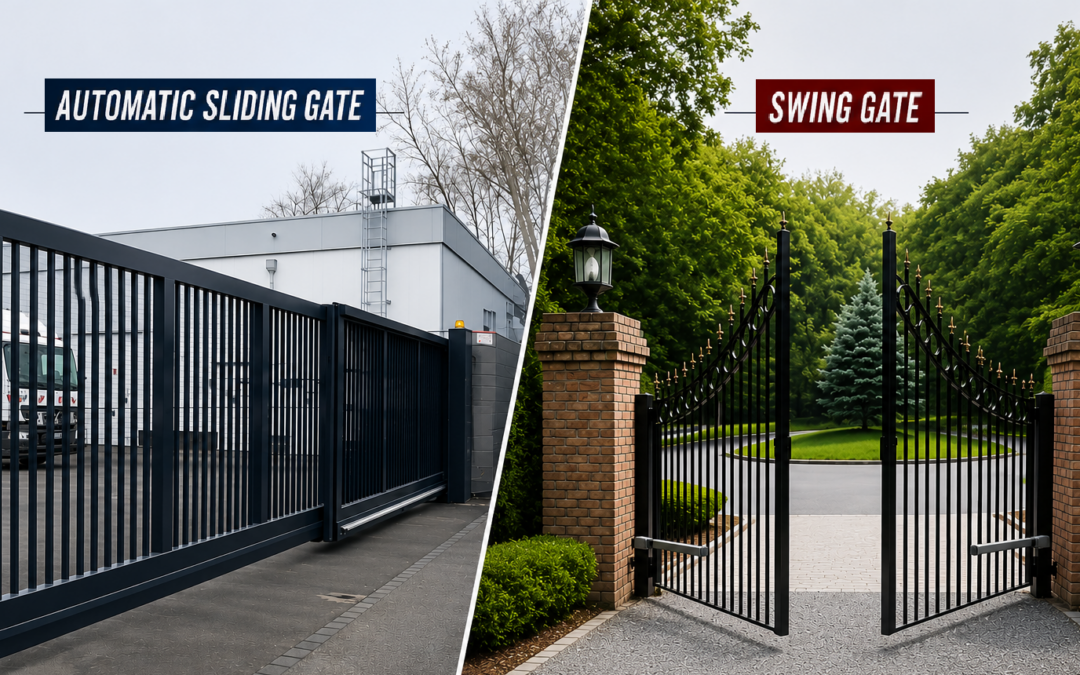
You’ve decided on an automatic gate. Now comes the harder question: sliding or swing? It sounds simple, but the wrong choice can cost you thousands in modifications — or leave you with a gate that physically can’t open on your block. This guide gives you the honest breakdown, suburb by suburb, dollar by dollar.
At SF Fencing, we’ve installed automatic gates right across Melbourne — from narrow terrace driveways in Fitzroy to wide acreage entries in Templestowe. The most common thing we hear after a site visit is: “I didn’t realise there were so many things to think about.” That’s what this article is for.
By the end, you’ll know exactly which gate type suits your property, terrain, aesthetic, and your budget — and you’ll have the questions ready to ask any installer before signing anything.
How Each Gate Type Actually Works
Before comparing the two, it helps to understand the fundamental mechanics. The difference isn’t just cosmetic — it determines what your driveway needs to accommodate and what happens every single time you arrive home.
Automatic sliding gates
A sliding gate travels horizontally along a fixed track that runs parallel to your fence or wall. A motorised rack-and-pinion drive system — housed inside the gate post — pulls the gate open and pushes it closed. The gate rolls on heavy-duty wheels or rollers that sit on a ground track (for cantilever-style gates, the track is elevated, avoiding the need for ground concrete).
The critical requirement: there must be enough clear space running alongside your driveway — along your fence line — for the gate to fully retract. A 4-metre-wide driveway needs at least 4 metres of clear side clearance for the gate to open completely.
Automatic swing gates
A swing gate operates exactly like a large door — it pivots on hinges mounted to a post or pillar, swinging inward toward your property or, less commonly, outward toward the street. Automation is achieved via a hydraulic or electromechanical arm motor that pushes and pulls the gate through its arc.
The critical requirement here is arc clearance — the gate needs unobstructed space to complete its swing. For inward-opening gates, that means nothing parked close to the gate when it opens. For outward-opening gates, the gate must clear the footpath or nature strip.
The 5 Factors That Decide Which Gate Suits Your Melbourne Property
There is no universally “better” gate. The right choice emerges from your specific site conditions. Here are the five factors that matter most — and a clear verdict on each.
1. Available space and driveway geometry
This is the single biggest determinant. Get this wrong and no amount of style preference matters — the gate simply won’t work.
Sliding gate: Needs clear space along the fence line equal to the gate width, plus an additional 600mm–1000mm for the drive post and end stop. If your property has a retaining wall, a side fence returning at 90 degrees, or a garden bed running right to the boundary, a sliding gate may not be physically possible without significant excavation or structural modification.
Swing gate: Needs clearance in the arc direction — typically in front of (or behind) the gate opening. The advantage is that swing gates don’t consume side space. The disadvantage is that cars, bins, or landscaping that creep too close to the gate’s swing path will prevent it from operating.
2. Driveway slope
Melbourne’s terrain is varied. Hilly suburbs like Eltham, Warrandyte, Templestowe, and parts of the Dandenong Ranges regularly present sloped driveways that fundamentally affect which gate will work.
Sliding gate: Handles slopes well. Because the gate travels horizontally along a track mounted at a fixed height, moderate gradients are easily accommodated. Cantilever sliding gates — where the gate is elevated off the ground entirely — are especially effective on uneven terrain because they don’t require a level surface to operate on.
Swing gate: More problematic on slopes. A gate that swings into a rising driveway will strike the ground mid-arc. Some swing gate motors can be set to lift slightly as they open, partially addressing this, but steep grades remain a real challenge. For cross-fall driveways (sloping side to side), swing gates are often ruled out entirely.
3. Security
Both gate types provide meaningful security over no gate at all. But there are real differences in vulnerability.
Sliding gate: The locking mechanism is built into the gate’s drive system and sits inside the motor housing — not accessible from outside. To force a sliding gate, an intruder would need to physically push the gate off its track or break the drive shaft. The gate also presents its full structural face to any attempted ramming rather than a hinged joint.
Swing gate: The hinges are the structural weak point. High-quality hinge design and robust post mounting address most of this vulnerability, but hinges — particularly on older or budget-installed swing gates — can be targeted. The locking point at the gate’s latching edge is also a potential attack surface.
For commercial fencing applications — warehouses, depots, industrial properties around Melbourne’s outer industrial corridors — sliding gates are almost universally specified for this reason. For residential use, both types provide adequate security when properly installed with quality hardware and automation systems.
4. Cost — upfront and over time
Cost comparisons between the two gate types are frequently oversimplified. The honest picture involves both upfront installation and long-term ownership costs.
Swing gate — upfront: Generally lower. The mechanism is simpler — a motor, a couple of arms, and hinges mounted to existing posts. No ground track, no concrete channel. Installation time is shorter. For a standard residential double swing gate with quality automation in Melbourne, expect to budget in the range of $3,500–$6,500 installed, depending on the gate material and motor specification.
Sliding gate — upfront: Higher, because of the track, concrete work, roller hardware, and motor system. A standard residential sliding gate in Melbourne, fully automated and installed, typically sits in the $5,000–$9,000 range. Cantilever systems — which avoid ground track concrete — are at the higher end.
Long-term: This is where the equation shifts. Swing gate hinges are exposed to weather, repetitive stress, and — in Melbourne’s coastal bayside suburbs — salt air corrosion. Hinge wear and sagging gates are common maintenance issues at the 5–10 year mark. Sliding gate mechanisms, being largely enclosed in the drive housing, tend to be lower maintenance over the same period when properly lubricated and serviced.
5. Aesthetics and architectural fit
Both gate types are available in a wide range of materials — powder-coated steel, aluminium slats, blade panels, timber, chain mesh — and both can be manufactured to virtually any design. But the opening movement itself creates a different visual character that should align with your home’s architecture.
Swing gate: The symmetrical opening of a double swing gate creates a grand, welcoming entrance. It’s a classic look that suits period homes — Federation cottages, Edwardian terraces, heritage red-brick properties in Essendon, Kew, Camberwell — where a tall, two-leaf wrought-iron or steel gate looks exactly right. Single swing gates are more casual and suit the same era of home at a smaller scale.
Sliding gate: The horizontal, linear motion of a sliding gate reads as contemporary and precise. It suits new-build homes, architect-designed properties, and the clean rectangular language of modern landscaping. A powder-coated aluminium blade or slat sliding gate on a rendered concrete pier is one of the most popular gate looks in Melbourne’s newer suburban estates — Pakenham, Point Cook, Craigieburn — for exactly this reason.
Side-by-Side Comparison: Sliding Gate vs Swing Gate
Here’s the full comparison at a glance. Use this as a checklist against your own property requirements.
| Factor | Sliding Gate | Swing Gate |
|---|---|---|
| Space requirement | Needs clear side clearance along fence line | Needs clear arc space in opening direction |
| Sloped driveway | Handles slopes well | Problematic on steep grades |
| Security | Higher — enclosed drive mechanism | Good — hinge quality matters |
| Upfront cost | Higher ($5,000–$9,000+ installed) | Lower ($3,500–$6,500 installed) |
| Long-term maintenance | Lower — enclosed mechanism | Moderate — hinge wear over time |
| Wind resistance | Better — travels with wind | Acts as a sail in strong gusts |
| Aesthetic fit | Contemporary, linear, modern | Classic, symmetrical, heritage |
| Installation complexity | Higher — track, concrete, rollers | Lower — simpler mechanism |
| Commercial use | Preferred — high cycle rating | Suitable for lighter applications |
| Noise level | Generally quieter operation | Can generate hinge noise with age |
Melbourne-Specific Considerations: Suburb by Suburb
Melbourne’s residential fabric is genuinely diverse — and the right gate for a Fitzroy terrace is different from the right gate for a Templestowe acreage. Here’s how the choice plays out across the city’s major regions.
Inner suburbs (Fitzroy, Richmond, Collingwood, South Yarra)
Narrow allotments, terraces, minimal side setbacks, shared driveways, and heritage overlays all constrain your options. Side clearance for a sliding gate is often simply not available. A single or double swing gate — often in steel or wrought iron to match the period architecture — is typically the only workable solution. Check heritage overlay requirements with your council before specifying a gate style.
Established middle-ring suburbs (Essendon, Bentleigh, Hawthorn, Camberwell, Glen Iris)
These suburbs offer more variety. Wide quarter-acre blocks often have enough side clearance for sliding gates, but the mix of house styles is broad. A sliding aluminium blade gate suits a renovated contemporary home. A double swing steel gate suits a period brick house with rendered pillars. Site measure first — don’t assume.
Outer east and north (Templestowe, Eltham, Warrandyte, Ringwood)
Larger blocks and hillier terrain define this region. Wide driveways and generous side clearance mean both gate types are viable in most cases. Sloped driveways — particularly in Eltham and Warrandyte — push many installations toward cantilever sliding gates, which handle uneven ground without requiring level concrete. The larger block sizes here also support longer swing gate arcs without obstructions.
Bayside suburbs (Brighton, Sandringham, Beaumaris, Black Rock)
Salt air from Port Phillip Bay accelerates corrosion on exposed metal components. For swing gates in bayside Melbourne, always specify marine-grade hardware — stainless steel hinges and fasteners, not galvanised steel. For sliding gates, a fully enclosed motor housing provides better protection. Powder-coat quality and sealing matters more here than anywhere else in Melbourne.
Outer growth corridors (Point Cook, Pakenham, Craigieburn, South Morang)
New-build estates with wide driveways, flat terrain, and contemporary architectural styles. Sliding gates are the dominant choice here for good reason — the block geometry accommodates them easily, the homes suit the linear aesthetic, and the higher security rating aligns with newer higher-value properties. Double sliding gates are increasingly popular on wider estate driveways.
Frequently Asked Questions
Can I automate an existing swing gate?
Do sliding gates need a concrete ground track?
Which gate type needs less maintenance?
Are swing gates suitable for a sloped driveway?
How much does automatic gate installation cost in Melbourne?
What happens to automatic gates during a power outage?
Do I need a council permit to install an automatic gate in Melbourne?
Which Option Does SF Fencing Recommend?
In our experience installing automatic gates across Melbourne, there are two situations where the answer is clear-cut and one where it genuinely comes down to personal preference.
Choose a sliding gate when: your driveway slopes, you have generous side clearance, your home is contemporary in style, you prioritise long-term security and low maintenance, or you’re specifying a commercial fencing installation. A sliding gate on a well-suited block is a precision, long-lasting installation that tends to give owners the most satisfaction over time.
Choose a swing gate when: side clearance is limited, your budget is tighter, your home is heritage or period in style, or your driveway is flat with clear arc space. A quality swing gate installation from a reputable Melbourne installer is a completely sound choice and will serve you well for many years with normal maintenance.
When either works: If your property can physically accommodate both — flat, wide, generous side clearance — then the decision comes down to aesthetics, budget, and your personal preference. In this situation, we invite you to view our gate gallery or come and see examples in person. A 20-minute consultation with our team typically resolves any remaining uncertainty.